
Protect Democracy projects that more than 34 million Americans have been impacted by mid-decade redistricting. Beginning in mid-2025, nine states, including Texas, California, Utah, and Missouri, adopted new congressional maps outside of the usual post-census redistricting process. The usual process redraws districts after each census to reflect population changes and uphold the constitutional idea of “one person, one vote.” When redistricting occurs outside of this process, it can be used to gain a partisan advantage. Researchers at Harvard University explain, “Mid-decade redistricting has happened before. What is unusual is the intensity of the current wave and the explicit partisan goal behind much of it.” Public opinion is also skeptical of partisan map-drawing: a 2026 survey conducted by YouGov found that only 7% of Americans believe that partisan gerrymandering should be allowed, while 71% say it should not. Ultimately, the surge in mid-decade redistricting in the past year raises questions regarding electoral fairness and could further reduce public confidence in American elections.
In the 2026 midterm elections, voters selected all 435 members of the U.S. House of Representatives. Going into the election, Republicans held the majority with 218 seats, to Democrats holding 214. With the House so narrowly divided, even a few seats flipped or kept could decide who has control of the chamber. Yet, before voters were able to cast their ballots, state legislators and courts shifted constituents between districts
The recent wave of mid-decade redistricting has not only sparked debate over partisan advantages, but might also be affecting voters' perceptions of what constitutes a fair electoral process. Pew Research Center reports that in July 2026, only 55% of Americans were confident that the midterms would be conducted fairly and accurately, down from 61% ahead of the 2024 elections. Voters are concerned their vote won't actually matter, that a politician has selected their district rather than a district selecting their representation. After this year's elections, exit polls report 60% confidence in election results, a slight increase from before the election, showing that voter confidence remained steady.
Texas and California lead the charge in mid-decade partisan gerrymandering. In August 2025, the Republicans in Texas, heeding calls from President Trump, redrew the state’s congressional map in order to net five additional seats.
Harvard Kennedy School professor Benjamin Schneer explains that the August map allows Republicans to maintain a lead, even if voters swing toward Democrats. California states responded to the Texas map. Governor Gavin Newsom (D-CA) signed the Election Rigging Response Act, which called for a special election the following November to disband California’s non-partisan redistricting commission and skew the maps in favor of Democrats. On November 4, Californians sided with Democrats, authorizing temporary congressional maps for the 2026, 2028, and 2030 elections, adding as many as five more Democratic-leaning seats. The competition between Texas and California to out-rig the others’ map highlights why voters question the integrity of their elections.
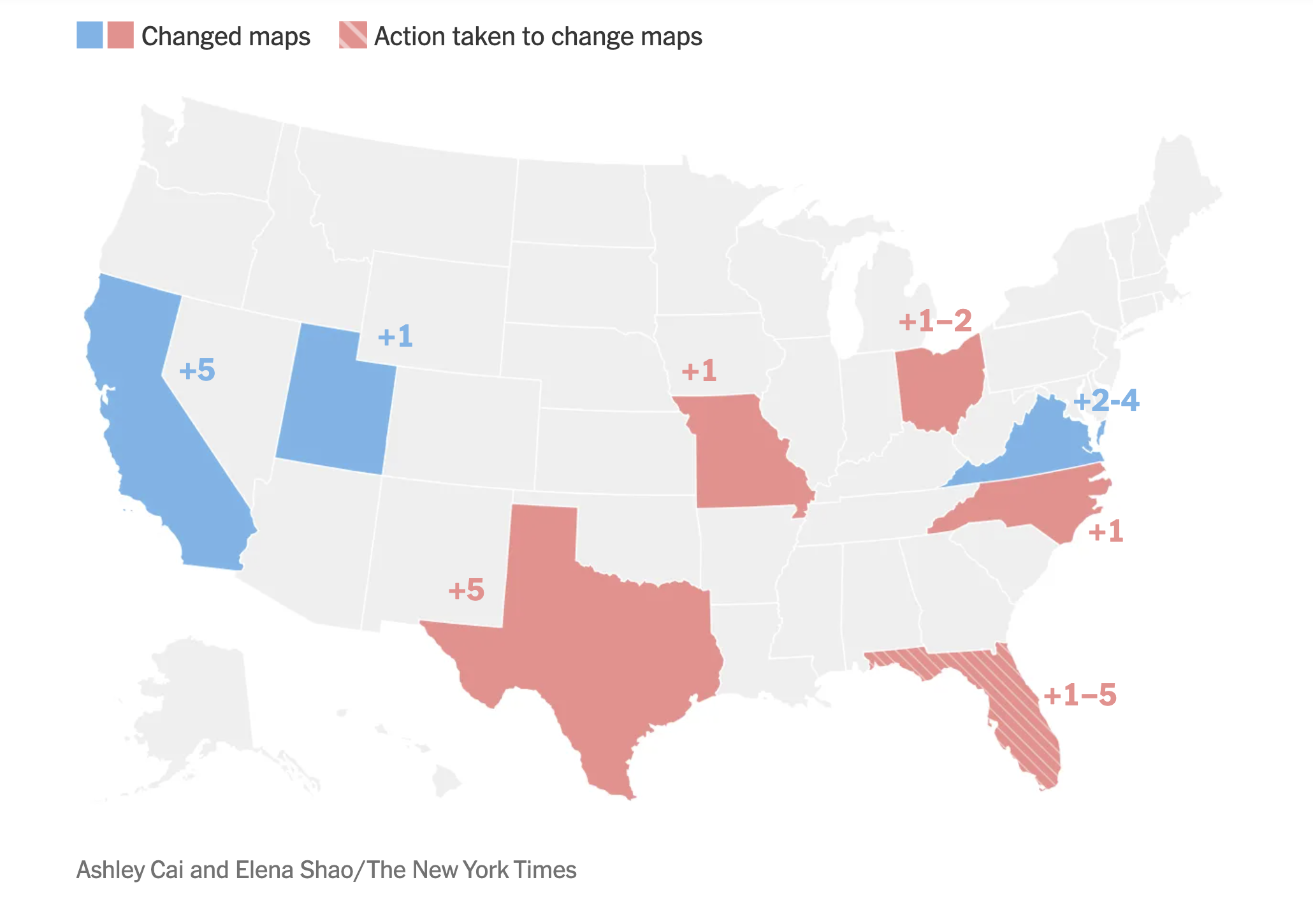
As illustrated in the map above, several other states have also redrawn maps ahead of the 2026 Midterms. In Utah, Judge Diana Gibson rejected a map drawn by the Republican-led legislature that would have kept all four of the state’s districts leaning Republican. Instead, she adopted a map drawn by the League of Women Voters of Utah and Mormon Women for Ethical Government, which created one new Democrat-leaning district. In Missouri, Governor Mike Kehoe (R-MO) signed a new map designed to expand the Republican advantage. Yet, the Missouri Supreme Court ruled that only a map voted on and approved by Missourians was acceptable. Due to the court's interference, the Republican Party lost the expanded advantage that the 2025 map would have provided. The court ordered the state to use the map adopted in 2022; the U.S. Supreme Court left that ruling in place.
When examining the results of the midterm elections, it can be seen that gerrymandering had a varying impact on securing, or maintaining, partisan advantages. Texas Republicans aimed to flip five seats; however, they only successfully flipped one seat. CBS News explains this failure is a result of “the shifts coincided with a slate of statewide Democratic wins in Texas, which elected its first Democratic senator and governor in decades.” While Texas Republicans fell short, California Democrats aimed for five new seats in the House, and successfully won all five seats. Additionally, Ben McAdams (D-UT) won Utah's new Democratic-leaning district.
As hundreds of newly elected representatives and many new governors begin their terms this January, changes are expected regarding redistricting processes. Newly elected Texas Governor Gina Hinojosa (D-TX) vowed to veto gerrymandered maps in Texas. In an August 5th press release, Hinojosa stated, “A rigged map still has to land on the governor’s desk. The governor of Texas can veto it… I will be that governor.” Moreover, in Georgia, Governor-elect Keisha Lance Bottoms (D-GA) vowed to veto any redrawn map that attempts to dilute the voting power of Black Georgians. At a campaign stop in Columbus, Bottoms told reporters, “Any map that dilutes voting of respective communities, I’ll veto.” With much of the power over redistricting belonging to state lawmakers, the numerous new governors taking office in January play a critical role in the future of gerrymandering. Ultimately, as redistricting battles continue across the country, their consequences go beyond partisan interest and will directly impact voter representation in future elections.